
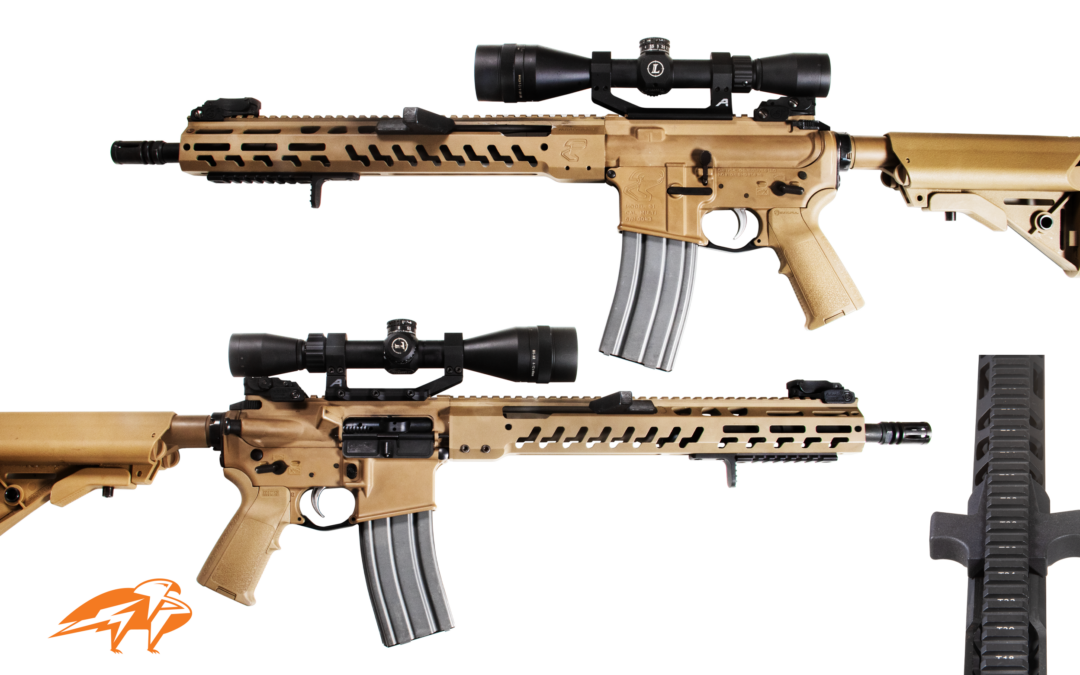
The charging handle is not a decoration. It is the main interface between you and the action, and it quietly controls how fast, clean, and consistent your AR-15 feels to run. If your charging setup forces you to break your cheek weld, fight your optic mount, or do the classic “reach-around” just to cycle the bolt, that is not a training issue. That is an interface problem.
Why modern optics made the rear charging handle feel “fine” instead of good
The original AR-15 rear T-handle made sense in its time. It was compact, centered, and protected at the back of the upper receiver. It also assumed a world where irons were the default and optics were smaller, lighter, and less invasive.
That is not the world most people are living in now.
LPVOs have larger eyepieces and bigger mounts. Red dot and magnifier setups often park a magnifier right where your hand wants to go. Night vision and thermal configurations can create even more stacking pressure around the receiver. The result is predictable: the rear charging handle becomes crowded, slower to access, and more likely to disrupt your position.
This is why charging systems matter more today than they did a decade ago. The question is not “Can I charge the rifle?” You always can. The question is “Can I charge the rifle without compromising the way I shoot it?”
What the charging system actually affects
People talk about charging handles like they are a minor upgrade. In reality, the charging interface influences almost every “manual action” moment a shooter experiences, including initial loading, administrative handling, chamber checks, and clearing interruptions. Even if you never touch the charging handle during a string of fire, you touch it constantly across real use.
A better charging system reduces wasted motion. It keeps your dominant hand where it belongs. It keeps your eyes where they belong. It also reduces the amount of rifle reorientation you have to do to get leverage, which is where many setups get clumsy when optics and gear enter the picture.
If you care about speed, consistency, or simply making the rifle feel like it was built for a human, charging is not a side quest. It is part of the core experience.
Rear charging
The traditional rear charging handle is popular because it is universal, familiar, and standardized. Parts availability is excellent, training transfer is easy, and almost every AR user already understands the manual of arms. If you run a relatively clean optic setup, or you prioritize commonality across multiple rifles, rear charging can still be the best answer.
The real limitation is not that rear charging is “bad.” The limitation is that rear charging lives in the same physical space as modern optic mounts and rear receiver clutter. When that space stays open, rear charging feels normal and efficient. When that space gets crowded, rear charging becomes a constant low-level annoyance that shows up in every manipulation.
Ambidextrous rear charging handles help, mostly by giving you more ways to grab the handle when one side is blocked or awkward. They do not change the location problem, but they do reduce the “one specific grip or nothing” frustration that basic handles can create.
If you want the deeper breakdown of how rear charging compares to the alternatives, Rear vs Forward vs Side Charging: Choosing the Best AR-15 Setup is a solid companion read.
Side charging
A side-charging AR-15 relocates the charging action from the back of the receiver to the side of the upper. That sounds like a small change. In practice, it changes how you interact with the rifle every time you need to cycle the bolt.
Instead of reaching back under an optic and yanking a T-handle, your support hand can run the action from the side with less disruption. It is a more direct motion and it tends to stay cleaner when you have a magnified optic mounted close to where it needs to be.
That is why so many shooters describe side charging as one of the few upgrades you actually notice immediately. If you want the blunt, real-world version of the argument, read Side-Charging AR-15: What’s the Point, and Is It Worth It? and compare it to your own experience running a rear handle under a modern optic.
Side charging does come with tradeoffs that people gloss over when they are in the honeymoon phase. Depending on the system, you can introduce proprietary parts, brand-specific compatibility constraints, and sometimes a different feel during maintenance or part replacement. That is not a dealbreaker, but it is part of making a grown-up decision. A practical look at the transition is covered in Switching from Rear-Charging to Side-Charging AR-15s.
Reciprocating vs non-reciprocating
Not all side-charging systems behave the same way, and the biggest dividing line is whether the handle reciprocates.
A reciprocating side charger moves with the bolt carrier group as the rifle cycles. Some shooters like the direct mechanical feedback and the “touch and feel” connection to the action. Others dislike having external movement on the side of the rifle, especially around gear, barricades, and awkward shooting positions.
A non-reciprocating side charger stays forward during cycling and only moves when you move it. That usually means less external motion, less chance of snagging, and a cleaner feel in general use. A straightforward explanation of this difference shows up throughout The Intricacies of Side-Charging AR-15s, and it is worth understanding before you commit to any side-charge platform.
If you do not know which style you want, default to this principle: if your rifle is built around modern optics and modern gear, reducing unnecessary external movement is usually a win.
Forward-mounted charging & optics
“Side charging” and “forward charging” get used interchangeably, but forward-mounted systems deserve their own category because they are not only moving the handle to the side, they are moving it forward to where the support hand already lives.
This is the part that makes forward-mounted charging feel less like a novelty and more like a refinement. Your support hand is already managing the fore-end, managing balance, and doing most of the work in reload and manipulation sequences. Forward placement shortens the travel your body has to make to run the action, and it keeps the rear receiver area clear for optics placement.
A clear breakdown of what changes with forward placement is laid out in What Sets a Forward Mounted Charging Handle Apart from Traditional Designs?, especially around optic clearance, reduced disruption to sight picture, and better access when your setup is not “range casual.”
Forward-mounted systems also tend to shine when you are wearing gloves, running slings, or dealing with the reality that rifles do not live in perfect conditions. If you want a use-case driven explanation of control and access, How a Forward Mounted Charging Handle Improves Rifle Control is a strong reference point.
Critical Objectives System forward-mounted, non-reciprocating, ambidextrous, optics-friendly
If your goal is an AR that stays easy to run with any optic configuration, the charging interface has to stop competing with the optic footprint. That is the logic behind Critical Objectives’ forward-mounted approach: move the charging interface forward, keep it non-reciprocating, and design it to stay out of the way of optics, gear, and normal rifle handling.
The most direct explanation of the system and how it is intended to be used is in Side Charging an AR-15 with an Ambidextrous, Forward-Mounted Charging System. If you want the “why it matters” angle from a capability standpoint, Forward Charging Handles and the Advantage It Brings expands on the interface advantages without pretending the charging handle is magic.
Competition shooters tend to notice the benefit fast because time penalties punish wasted motion. That perspective is covered well in What Competitive Shooters Gain from a Forward Charging Build, especially around staying in position and reducing unnecessary movement between actions.
How to choose the right charging setup without lying to yourself
Choosing a charging system is not about what looks cool on a spec sheet. It is about what your rifle demands based on optics, handling style, and the conditions you actually operate in.
If your rifle is a simple build with a basic optic and nothing blocks the rear handle, rear charging is still a perfectly rational choice. In that setup, the standard interface is efficient because it is unobstructed, familiar, and easy to support with parts.
If you are running magnified optics, especially anything that pushes eye relief and optic position into the rear receiver area, the rear handle becomes a recurring friction point. An ambidextrous rear handle can reduce that friction, but it does not eliminate the physical crowding that caused the problem in the first place.
If your optic setup consistently blocks access, or if you are tired of breaking position to run the action, side charging is the first major interface upgrade. It moves the control away from the rear receiver area and gives the support hand a more natural job.
If your build is optics-heavy and you want true freedom to place glass where it performs best, forward-mounted charging is the cleanest answer. It removes the rear receiver congestion entirely and shifts manipulation to the area of the rifle where your support hand already works. That is why forward-mounted designs are often described as “optics compatible” by default rather than “optics compatible if you compromise your layout.”
Ergonomics should keep these decisions honest. If you want the philosophy side of that argument, Ergonomics and the Streamlined Rifle Setup is worth reading, because it frames rifle setup the right way: reduce distraction, reduce friction, keep only what contributes to performance.
Comparison table: what changes as you move away from rear charging
| Charging setup | What it does well | What it tends to struggle with | Best fit |
|---|---|---|---|
| Standard rear charging | Common, simple, familiar, widely supported | Optic crowding, reach-back motion, more disruption in awkward positions | Basic builds, shooters prioritizing standardization |
| Ambidextrous rear charging | Better access from either side, improved handling across handedness | Still crowded by large optics and rear receiver space constraints | Rear-charging users who want improved access without changing systems |
| Side charging (receiver area) | More direct support-hand manipulation, less rear receiver interference | Can introduce compatibility constraints depending on design | Optics-heavy builds, shooters who want less disruption during manipulation |
| Forward-mounted side charging (non-reciprocating) | Maximizes optic clearance, shortens movement, keeps manipulation near the support hand | More specialized system choice, requires intent in build planning | Optics-first setups, serious use cases where access and consistency matter |
Common misconceptions that keep people stuck with a frustrating setup
“If it’s awkward, I just need more reps.”
Training matters, but training does not change physics. If your optic mount blocks access to the rear handle, no amount of reps will make the space bigger. What reps can do is help you work around the problem. What better hardware can do is remove the problem.
“Side charging is only for competition.”
Competition makes inefficiency obvious, but the interface advantages of side and forward charging show up everywhere: hunting positions, cold weather gloves, tight sling setups, and any scenario where you want to keep your dominant hand planted and your eyes on the optic.
“Rear charging is always more reliable.”
Reliability is not a moral property of handle location. Reliability comes from design quality, tolerances, materials, and how well the system is executed. If you are thinking about “how much reliability costs,” The AR-15 and the Price of Reliability is a useful mindset reset.
FAQ
Is a forward-mounted charging system the same thing as a side charger?
They are related, but not identical. Side charging describes the handle being on the side rather than at the rear. Forward-mounted charging describes the handle being placed farther forward, closer to the support hand, which changes access and reduces interference with optics at the receiver.
Do I need to change my optic placement if I switch charging systems?
Usually it is the opposite. Many shooters switch charging systems because they want to place optics based on performance and eye relief, not based on whether their hand can still reach a rear T-handle under a mount.
Is non-reciprocating always better?
“Better” depends on priorities, but non-reciprocating designs are often preferred for modern, gear-aware builds because they reduce external movement and keep the interface consistent during cycling. If you are weighing the two styles, The Intricacies of Side-Charging AR-15s is a good explainer on how the difference plays out in use.
What is the most practical upgrade if I want better handling but I am not ready to change uppers?
If your main issue is access and leverage around optics, an ambidextrous rear handle can help. If your main issue is that the rear receiver area is physically crowded, that is where side charging or forward-mounted charging becomes the real solution.
Keep going: deeper reads on charging systems
If you want to keep digging, these articles expand on the key concepts from different angles: Rear vs Forward vs Side Charging: Choosing the Best AR-15 Setup, Side-Charging AR-15: What’s the Point, and Is It Worth It?, What Sets a Forward Mounted Charging Handle Apart from Traditional Designs?, and How a Forward Mounted Charging Handle Improves Rifle Control.
Product and dealer questions
If you are evaluating a forward-mounted, non-reciprocating charging system for an optics-heavy build and you want specs, fit guidance, or availability details, use the Contact Us page. If you are a dealer looking to carry Critical Objectives products, start at Dealer Inquiry. If you want the background on why the company builds the way it does, About Critical Objectives covers the story and manufacturing focus.
Safety note: Always follow safe firearm handling and all applicable laws. If you are unsure about component compatibility or installation, work with a qualified armorer or gunsmith.