

Maybe your build is just about where you want it. You like the optic, the grip feels right, and the rifle runs well. Then there’s that cramped reach to the rear charging handle.
With your scope and mount in place, you’d prefer a little more space.
…And you’re back comparing parts.
The spare-parts bin tells you a lot about how your preferences have changed. There’s probably a perfectly decent grip or stock in there that was exactly what you wanted two builds ago.
Now, an AR-15 side charging handle upgrade brings a few different ideas into the conversation. A bigger latch gives your fingers more surface to work with. An ambidextrous charging handle provides access from either hand. A side or forward charging system changes the control’s location.
The details are big here, because “ambi,” “side charging,” and “forward charging” don’t all mean the same thing.
The appeal of a forward-mounted layout is that the control sits closer to the support hand, away from the space behind the optic. That gives you another way to approach the layout of your rifle. Before getting too far into the parts list, it helps to understand what each design changes and how it fits with the setup you actually have.
What the Charging Handle Does
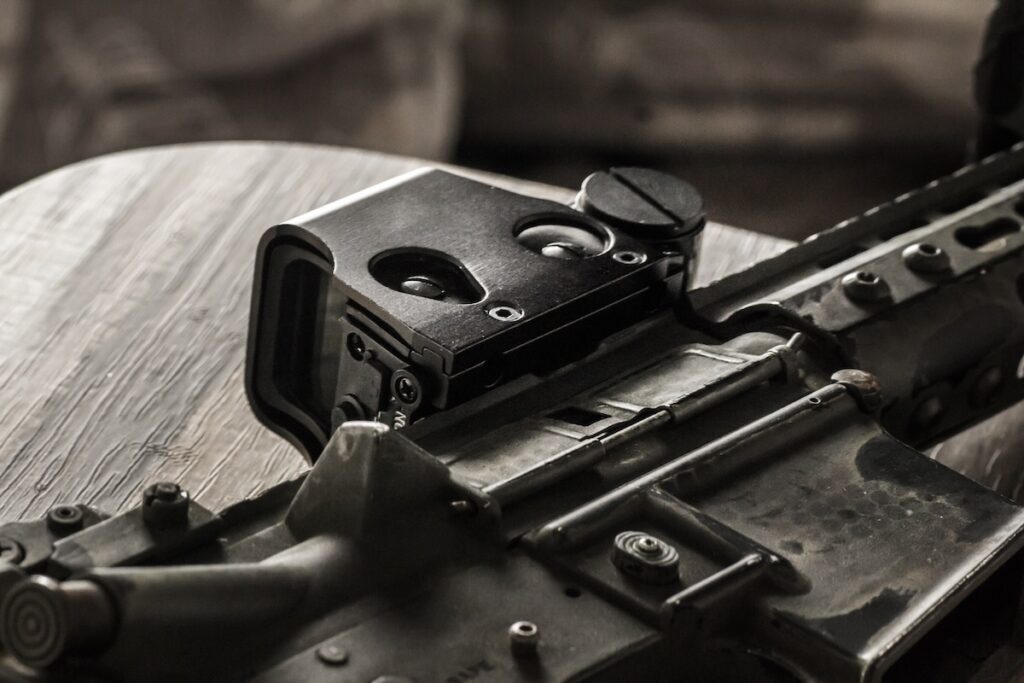
On an AR-15, the charging handle provides a way to retract the bolt carrier group manually. Its location and shape affect accessibility, particularly when optics and other equipment occupy nearby space. For someone learning the terminology, the key point is that the control is part of a larger mechanism.
On a conventional AR-15, the familiar T-shaped control sits at the rear of the upper receiver. A lot of aftermarket replacements keep that position while changing the latch geometry, materials, or access from either hand. A replacement can look substantially different in an isolated photograph, but still occupy basically the same place on the firearm.
Some designs change the surface you interact with. Others relocate the interface. Both are relevant to ergonomics, and they answer different questions.
Now, before getting into finishes, dimensions, or a price range, it helps to establish which of those changes a particular AR-15 side charging handle upgrade actually offers.
How Side Charging Designs Differ

A side charger places the control along the side of the firearm. The term covers several architectures, so two products described this way can have substantially different layouts and compatibility requirements. It’s a category description, with considerable variation inside it.
Some designs place the control beside the receiver. A forward-mounted design positions the interface farther toward the handguard, separating it from the rear area where a scope’s eyepiece or other equipment may occupy space. That forward location brings the control closer to the support hand. The layout is intended to reduce the need to disturb the firing grip or head position when accessing the charging handle.
You’ll also encounter “reciprocating” and “nonreciprocating.” These describe whether the control moves with the action during firing. A nonreciprocating handle stays stationary during that cycle. The familiar AR-15 rear charging handle is nonreciprocating too.
Side charging designs can use either arrangement.
There’s a separate question about handedness: A lateral control might be fixed to one side, configurable for either side, or available in a configuration with access from both. “Either side” and “both sides” mean different things here.
Where an Ambidextrous Charging Handle Fits
An ambidextrous charging handle provides access from either side. In the familiar rear-mounted format, its paired controls sit at the rear of the receiver. Ambidextrous access and forward placement are separate characteristics. A conventional replacement can offer the first without changing the second, and a forward architecture can incorporate ambidextrous access into a different overall layout.
Familiarity has a lot of pull in these discussions. After years with one layout, “that feels right” and “that’s what I’m used to” can sound an awful lot alike.
Even within the conventional category, dimensions and exterior shapes vary. Some designs have prominent wings; others present a smaller profile. “Ambidextrous” doesn’t tell you how wide the part is, whether its exterior is symmetrical, or how its surfaces are shaped. Those details become apparent through measurements, information, and photographs of the actual AR-15 handle upgrade.
Goes without saying but hands differ, too. What feels roomy to one owner can feel bulky to the next guy. A description such as “oversized” provides a relative impression, dimensions give that impression a reference point.

A rear-mounted ambidextrous charging handle can address handedness preferences while preserving the rear location. But forward designs can offer left-, right-, or dual-handle configurations, bringing both location and handedness into the discussion. Keeping those characteristics separate makes the terminology easier to follow: ambidextrous access describes operation with either hand, while mounting position describes where the control sits.
The thinking behind ambidextrous handgun controls applies here, too: right-handed shooters can benefit from access with either hand. Southpaws have especially good reason to care about control placement, of course. They’ve spent enough time adapting to somebody else’s idea of where everything should go. Having options is a welcome change.
Optics Clearance
A scope, its mount, and nearby accessories create a particular spatial relationship around the rear controls. The size and position of the scope’s eyepiece and mount affect how much room is available around a rear charging handle.
A large latch or extended latch increases the available contact surface. The charging handle remains in its original location, which means the surrounding equipment is still part of the picture.
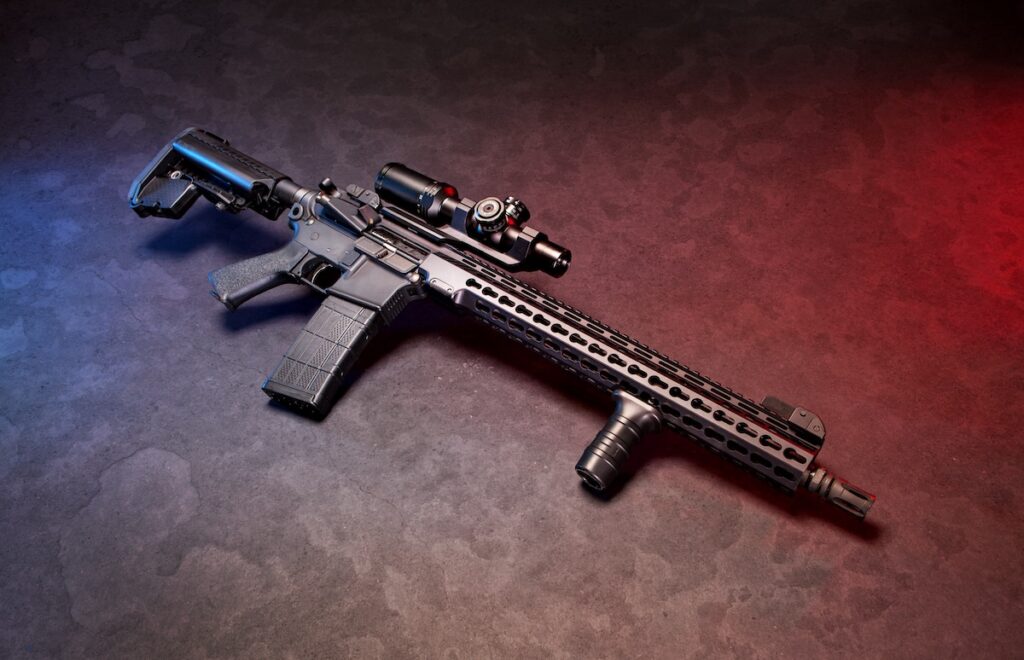
Forward charging designs address location directly. Their ergonomic appeal includes separating the interface from the area behind the optic. The resulting separation can reduce interference between the optic and access to the charging handle. Naturally, exact clearance is a model-specific question.
The type of optic changes what’s occupying that space, too. A compact red dot sight is a different package from a holographic sight paired with a magnifier. That second setup brings another optical housing and, commonly, a flip-to-side mount into the mix. An LPVO combines its magnification range into one scope, with an ocular housing, magnification ring, and sometimes a throw lever near the rear.
Scope rings, a cantilever mount, quick-detach levers, and a folding rear iron sight all have their own physical dimensions. A parts list might simply say “optic and mount.” But on a rifle, that can describe quite a collection of hardware.
Eye relief and eye box add another thing to think about.
- Eye relief is the distance between your eye and the ocular lens where the full image is visible.
- The eye box is the usable space behind the optic that allows that view. Outside it, you can see dark edges or scope shadow.
An unmagnified red dot generally allows much more freedom in eye position than a magnified scope. Add a magnifier, and that magnifier brings its own eye relief and alignment requirements. A scope can also have a fairly compact housing without having a particularly forgiving eye box. So… when someone describes an optic setup as “comfortable,” they might mean the cheek weld, the view through the glass, or the room around the controls. And those are all separate parts of how the complete setup feels.
Materials
Billet describes the starting stock used in a manufacturing process. Forging describes another manufacturing route. The alloy, heat treatment, finish, and quality of the machining also contribute to the finished part.
The distinction between the body and the rest of the assembly matters, too. The body, latches, pins, and other small parts can use different materials. The material used for the main body is only one part of the assembly’s construction.

Fit, finish, and long-term durability matter for a billet handle assembly just as they do for a forged one. How the moving parts fit together and hold up with use contributes to the feel and service life of the assembly.
The useful follow-up to “never had a problem” is “How much time have you got on it?” One good range trip, and several years of use, probably deserve different weight in the conversation.
Comparing Designs Within the Right Category
Useful comparisons begin with equivalent products. A conventional ambidextrous charging handle, a receiver-mounted lateral system, and a complete forward charging platform represent different scopes of change. Comparing like-for-like options makes it easier to see what each design changes.
Product families sometimes include multiple sizes, configurations, or generations. A review of one variant may offer background on the family, but its observations shouldn’t automatically be carried over to every item sharing the same name. Same family doesn’t necessarily mean the same part.
When reading reviews, look for clearly identified models, disclosed testing, and a distinction between observation and opinion. “Comfortable” describes someone’s experience. A published dimension describes a measurable feature. Both can be useful when presented honestly. Broad praise is harder to use when the setup and testing are left out. A few specifics go a long way.
Ask somebody what they’d buy again if they were starting over. That can get you a much better conversation than another round of defending whatever’s already on the rifle.
Compatibility
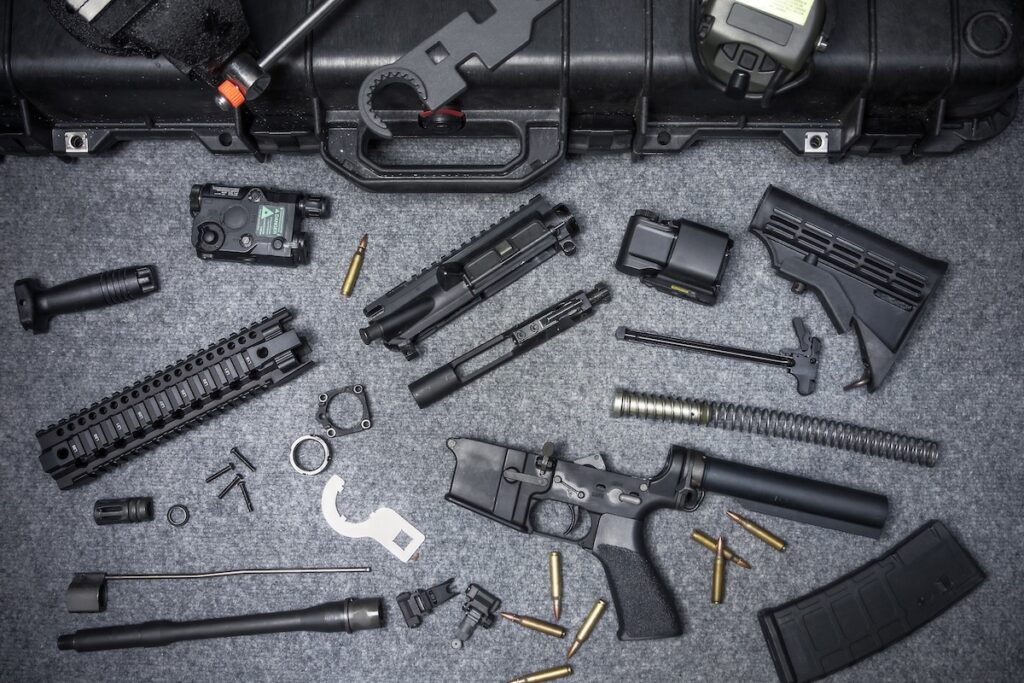
AR-15 parts aren’t all interchangeable. Replacing a rear charging handle and switching to a forward charging system can involve different parts and compatibility requirements. Some forward systems work with a standard lower receiver, so a different charging layout doesn’t necessarily mean starting over with an entirely different rifle.
Before ordering any aftermarket parts, you can always ask the manufacturer what works with your particular setup and what’s included in the box. And if the system uses any unique parts, find out whether replacements are available.
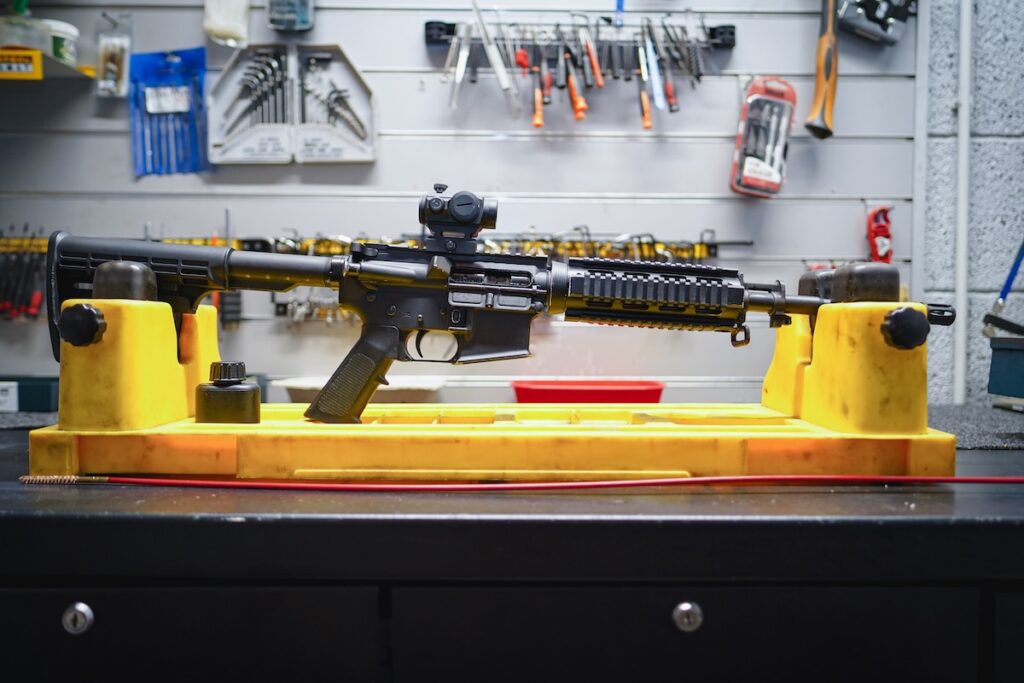
It’s also worth knowing what installation involves before the package arrives. If you’re unsure about fit or the work required, a qualified gunsmith or armorer can check your setup and explain what needs to be done.
Price Range
The price range for a standalone replacement part describes a different purchase from a complete system. First, check what’s actually in the box. A higher total may reflect a broader collection of components, a different architecture, or additional services. Without that context, a price comparison can tell you more about the size of the package than the value of its individual features.
Read a sale listing for the exact model, included components, warranty terms, and return conditions. A sale price might apply to a particular finish, version, or cosmetic condition.
Keep the price range tied to equivalent categories, then consider ownership beyond the initial purchase. Warranty coverage and access to replacement parts also matter when comparing the long-term cost of ownership.
Common AR-15 Side Charging Handle Upgrade Questions
What is the best side charging handle for an AR-15? There’s no universal winner here. Layout, handedness, documented compatibility, and manufacturer support determine whether a design suits a particular owner. Forward-mounted systems are a distinct category worth understanding when rear control access is the concern.
Are upgraded charging handles worth it? They can be worthwhile when their documented features address a specific ergonomic preference. An ambidextrous charging handle offers a different access arrangement, while an extended latch changes the contact surface. The question is whether that change matters on your setup. Price, finish, and popularity can help describe a product, but none establishes that it will be a meaningful improvement for everyone.
Is a side charging AR-15 worth it? Its value depends on whether the alternative layout suits the owner’s needs and expectations. Evaluate the complete firearm, including its documentation, service support, and any design-specific requirements. A forward, nonreciprocating arrangement combines an accessible control location with a handle that stays stationary during firing. The strongest case for it rests on those identifiable characteristics and the quality of the complete system.
Is there an upgraded charging handle available for the AR-15? Yes. The AR15 accessory market includes enlarged-latch replacements, ambidextrous designs, and alternative architectures. These options span individual accessories and more extensive systems. Availability for a particular configuration should be confirmed with the manufacturer. It’s especially useful to distinguish between replacing an existing control and choosing an architecture that locates the interface elsewhere, because the scope of those purchases differs.
So, start with the distinction between contact surface, ambidextrous access, and control placement. Those three ideas explain much of the terminology and keep comparisons focused on what each design actually changes. A forward layout makes the location of the interface a central design choice, which deserves consideration alongside conventional rear-mounted options.
From there, the useful details are fairly concrete: documented dimensions, materials, compatibility, included components, and support. Give those details room in the comparison. They help connect the features of each design to your own setup and preferences. That’s a sound basis for understanding the available designs and deciding which features deserve closer attention.
The Bottom Line

Post an AR online and somebody will tell you what they’d change. Sometimes there’s a useful idea in there. Sometimes you’ve just been handed the parts list for the rifle they would’ve built. Both are pretty normal in this hobby.
The most useful AR-15 upgrade conversations leave some room for “I hadn’t thought of doing it that way.” That’s a good attitude to bring to a different charging layout, too. Ask questions, hear from people who’ve spent time with it, and form your own opinion. Having a favorite setup and being curious about another one can comfortably coexist. Most spare-parts bins can confirm that.